Write a Care Card That Matches Every Item in a Studio Kit
Create a readable care card for a studio sock-and-prop kit using confirmed instructions for each actual product, with clear references and version control.
A sock-and-prop kit should not use one generic care instruction for every component. Collect the confirmed information for the actual sock, mat and block, then organize it so the recipient can quickly identify the instruction that belongs to each item. The care card is a communication tool, not a place to invent a missing product procedure.
Start before packaging approval. If the product choices are still changing, keep the care layout provisional and identify the information that remains open. Printing a polished card too early can leave the studio with instructions that no longer match the final set.
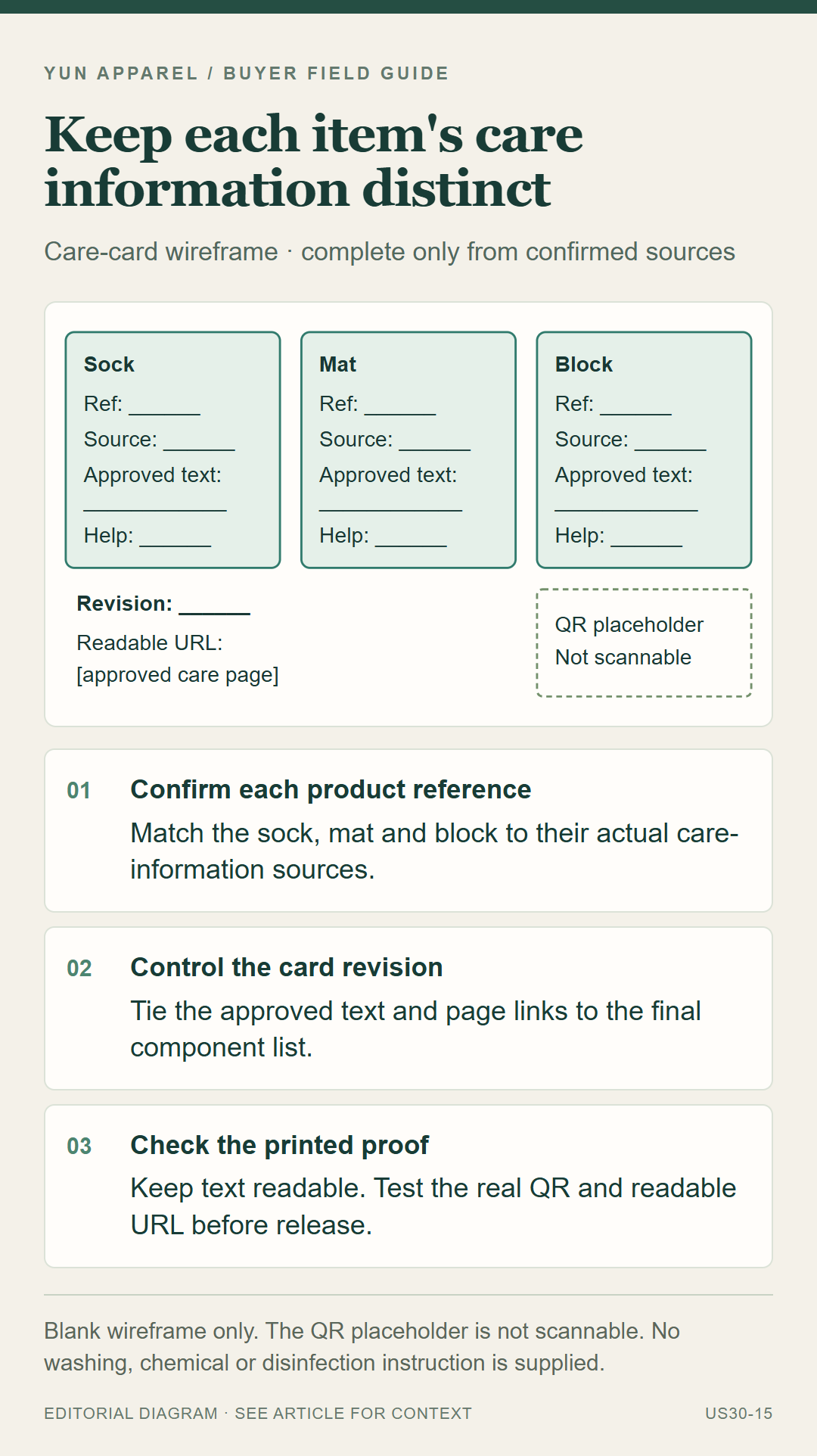
Concept illustration. Blank wireframe only. The QR placeholder is not scannable. No washing, chemical or disinfection instruction is supplied.
Request the product-specific source
For each component, record the product reference, the source of its care information and the version or date received. Ask the responsible supplier to resolve gaps or contradictions. Do not copy a procedure from a visually similar item or assume that a material name supplies all the necessary instructions.
Manduka's care guide gives different directions for different mat models and distinguishes routine cleaning from disinfection. Its guidance applies to the products it identifies; it is not a universal procedure for another supplier's mat. Manduka model-specific mat care guide That distinction is a useful reason to keep your own kit information product-specific.
Build a separate panel for each component
Use the same visual structure across the card while preserving the separate instructions. A member should be able to find the sock panel without reading through the mat information first. If two similar-looking accessories have different requirements, make their product references easy to distinguish.
| Panel element | What to include |
|---|---|
| Item identity | Plain product name and relevant reference |
| Approved care text | Instructions confirmed for that exact item |
| Handling or storage information | Only what the product source supports |
| Further information | Maintained page or other accessible reference |
| Help route | Contact for unresolved product questions |
Use icons only when their meaning is clear and the underlying instruction is confirmed. A decorative symbol should not imply a care method that the text does not support. Keep essential information readable rather than reducing it to tiny type to preserve a large brand mark.
Separate consumer information from studio procedures
A personal kit card describes the recipient's products. A shared-equipment procedure may involve additional responsibilities, records and suitability checks within the studio. Do not assume the personal care card alone establishes an appropriate shared-use process.
If staff need further guidance for an intended use, obtain it from the relevant product provider and responsible studio personnel. Avoid adding words such as “disinfects,” “sterilizes” or “safe for all surfaces” without support for the exact statement. This article does not recommend a cleaning agent, temperature or disinfection method.
Make the information survive the handover
Review the card inside the assembled package. Is it visible when the recipient opens the set? Does the product name on the card match the name on the item or its band? Can the member still find the information after separating the components?
A maintained online page can provide more detail, but the card should not become an unexplained code. Include a readable route to the information and identify what the member will find there. Test any QR code on the actual printed proof and check the destination before release.
Do not replace required product labels with a promotional insert merely because the insert looks clearer. Have the appropriate requirements for the destination and product confirmed separately when preparing the final packaging.
Control revisions with the product set
Assign a card revision and tie it to the approved component list. If a mat source, sock composition or accessory reference changes, review whether the information needs updating. Keep obsolete cards out of the packing area so an old insert is not placed in a new set by habit.
Ask a colleague unfamiliar with the project to identify each item and find its instructions. Record confusing names, small text or broken links, then correct the proof before approving printing.
Questions studio owners ask
Can we shorten supplier instructions to fit the card?
You can improve presentation, but do not remove conditions or change meaning. Confirm any condensed wording with the responsible source, and provide access to the full applicable information where needed.
Should a kit use one online care page or several?
Either can work if the actual products and instructions remain easy to identify. A single page should have distinct sections, while separate pages need clear links. Keep the page references synchronized with the packaged items.
Request care information with the products
When discussing custom cotton socks, packaging and coordinated accessories with Yun Apparel, include the care-information requirement in the brief. Confirm each product before approving the final branded card.