Retail or Loaner Socks? Map the Work Before Choosing
Compare selling and lending studio socks by the full issue-to-return process, staff responsibilities, ready stock and actual operating costs.
A studio comparing retail and loaner socks should map the whole operating cycle. Selling a pair ends with a recorded handover, subject to the studio's normal customer-service process. Lending a pair creates further work: return, sorting, product-appropriate care, drying, inspection and a decision about whether it is ready to issue again.
The right arrangement depends on the studio's policy and its ability to carry out that work consistently. A purchase price alone cannot show the cost of a loaner program, and a basket of returned pairs is not the same thing as available stock.
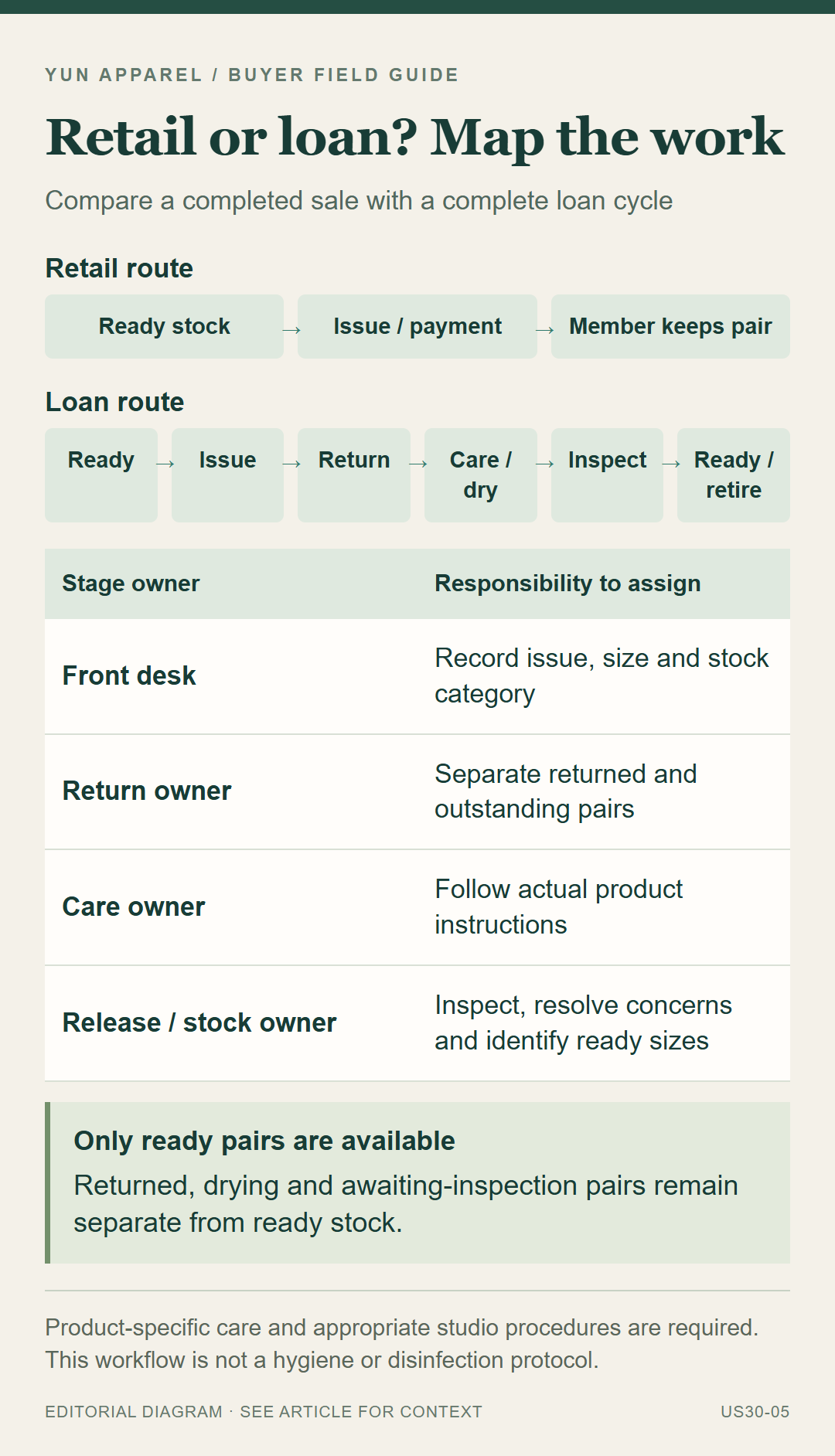
Concept illustration. Product-specific care and appropriate studio procedures are required. This workflow is not a hygiene or disinfection protocol.
Describe the service you intend to offer
Decide whether a loan is an occasional exception, an included service or a routine option for every visit. Define who can authorize it and how the visitor will understand the return process. If socks are sold instead, explain the current price and any membership benefit before handing over a pair.
STRONG's published first-visit guidance includes an in-studio purchase option. It establishes one visible operating model, not a universal answer for other studios. STRONG first-visit guidance A studio choosing a loan model must design its own process rather than assume that a retail workflow can simply be reused.
Give every stage an owner
Walk the physical route from the desk to the return point and through the preparation area. Identify where pairs wait at each stage. The aim is to prevent staff from confusing issued, returned, awaiting-care and ready-to-use items.
| Stage | Responsibility to assign | Record or condition |
|---|---|---|
| Issue | Front desk or designated colleague | Pair, size and issue status |
| Return | Person checking the return point | Returned versus still outstanding |
| Preparation | Trained responsible colleague | Actual product instructions followed |
| Inspection | Person authorized to release stock | Condition checked; concerns separated |
| Ready storage | Stock owner | Clear ready status and size location |
Use the actual product's care instructions and the studio's appropriate hygiene procedures. This workflow does not prescribe cleaning chemistry, establish a disinfection method or guarantee hygiene. If the instructions do not address the intended shared-use process, resolve that gap before starting the service.
Count ready pairs separately
A simple status count can expose an operational bottleneck. In a hypothetical example, a studio owns 24 loan pairs: eight are ready, six are awaiting preparation, four are drying, three are currently issued and three are awaiting inspection. Only the eight ready pairs are currently available for another issue.
If the desk keeps running short while many pairs are waiting between stages, first investigate the workload and space. Buying more pairs may increase the queue without solving it. The count should also be split by size because eight ready pairs in one size cannot be treated as eight suitable options for every visitor.
Measure the work over a complete cycle
For a trial, record active staff minutes for issuing, collecting, sorting, preparation and inspection. Track supplies, applicable care charges, missing pairs and retired items separately. Avoid dividing all costs by the number of pairs originally purchased when the question is the cost per completed loan cycle.
Use the same period and scope when comparing alternatives. For example, include retail handling time in the retail model and loan handling time in the loan model. A colleague who performs preparation during an otherwise quiet period still spends time on it; record the minutes even if no additional shift was scheduled.
At the review, consider service outcomes as well as cost. Were suitable sizes ready when needed? Did returns interrupt class changeover? Were staff clear about releasing prepared stock? Keep the answers practical and specific to the trial.
Questions studio owners ask
Can a studio offer both retail and loan pairs?
It can design that arrangement, but the categories need separate identification and records. A returned loan pair should not be mistaken for unopened retail stock. Staff also need a clear explanation of when each option is available.
How should we handle a pair with an unresolved condition concern?
Keep it out of ready stock while the responsible person assesses it using the studio's process and product information. Recording it as “awaiting review” makes the uncertainty visible instead of passing the decision to the next colleague.
Scope the product discussion
Tell Yun Apparel whether the proposed custom cotton socks are for retail, gifts or a planned loan service. Ask for the actual product and care information needed to evaluate that use; a branding discussion alone does not establish suitability for repeated shared use.