Should Studio Mats Be Retail Products, Shared Equipment or Member Benefits?
Compare retail mats, shared studio equipment and member-benefit mats by ownership, branding, handover and ongoing responsibilities.
Choose the ownership model before requesting a mat quotation. A mat sold to a member, a mat kept in the studio and a mat promised within a membership offer create different responsibilities. They may look similar on a mood board, but their storage, handover, care information and stock records should not be treated as interchangeable.
The model also affects branding. Shared equipment may need clear identification within the room, while a personal product needs a presentation the recipient can understand and take away. Start with the operating purpose, then review the actual product and approved brand treatment.
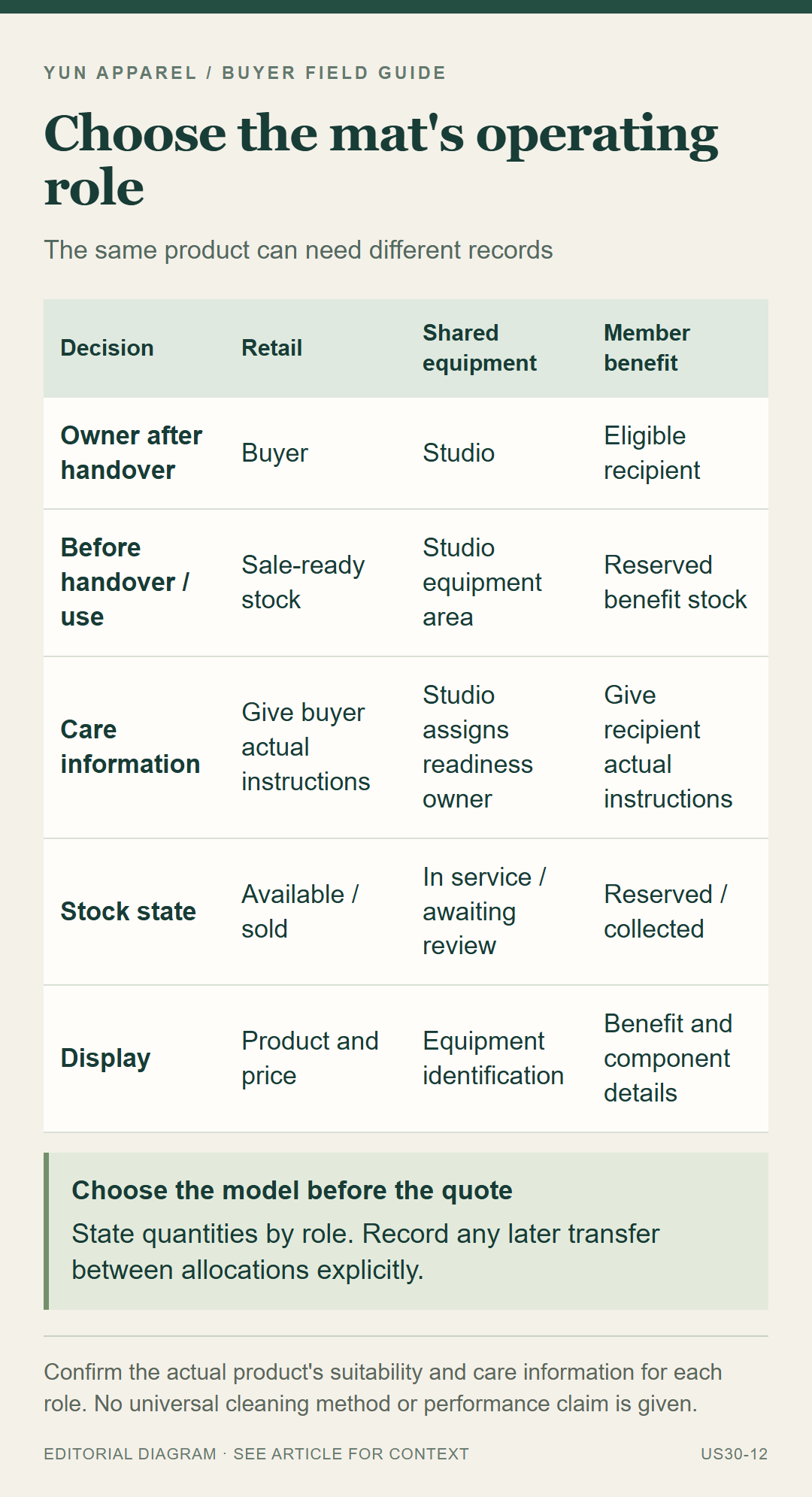
Concept illustration. Confirm the actual product's suitability and care information for each role. No universal cleaning method or performance claim is given.
Understand the three models
For retail, the studio offers a defined product for purchase. The member needs accurate product information, the current price and the studio's applicable customer-service terms. The team needs to distinguish sale-ready units from display samples and other allocations.
For shared equipment, the studio retains the item and manages its ongoing readiness. Assign responsibility for storage, product-appropriate care, inspection and replacement decisions. Do not assume that an item is ready for another class merely because it has returned to the equipment area.
For a membership benefit, the studio has promised an eligible recipient a product under an offer. The handover is fulfillment of that promise. The stock must remain visible as committed even if the member has not yet collected it.
| Decision | Retail | Shared equipment | Member benefit |
|---|---|---|---|
| Intended owner after handover | Buyer | Studio | Eligible recipient |
| Main stock state | Available for sale | In service or awaiting review | Reserved or collected |
| Presentation need | Product and price information | Clear equipment identification | Benefit and component information |
| Ongoing studio task | Customer-service process | Readiness and maintenance process | Resolve outstanding promises |
Use public examples without copying their promises
Calibrate's founding-membership page includes a mat choice in some benefits, while ora's heated-mat guidance asks participants to bring their own mat. These are different published arrangements, not evidence that one is better or that either studio needs a new supplier. Calibrate Pilates founding memberships ora studios class guidance
For your own studio, ask which arrangement fits the class setup and the member offer. If the model is mixed, identify the quantities and responsibilities for each part. Do not let a single purchase order conceal the difference between a shared-equipment reserve and products already promised to members.
Review the product through its actual journey
For a retail mat, walk through the display, product explanation, packaging and carrying experience. Can a buyer identify the exact model and find the care instructions? Is the branding visible without hiding useful information? Does the proposed package work for the way the member will take it home?
For shared equipment, review the actual storage area and the documented care requirements. Ask the responsible team whether the preparation process fits the room and schedule. Resolve missing product instructions before putting the mat into service; this article does not supply a universal cleaning procedure.
For a membership benefit, check whether recipients choose between products or receive one specified item. Record the selection and the handover separately. If the promised item is delayed, keep the outstanding obligation visible and explain the real options rather than substituting a different product silently.
Keep allocation changes explicit
If the studio transfers a retail unit into shared use, record the change. If a display sample becomes unsuitable for normal retail sale, update its status. A mat can move between roles only through a conscious decision with the appropriate condition review and information updates.
Review the quantity in each category at an agreed interval. This helps the owner see whether money is tied up in uncollected benefits, whether equipment is waiting for review or whether the retail range has more variants than staff can explain clearly.
Questions studio owners ask
Can one mat product serve all three models?
Potentially, if the actual product is suitable for each intended use and the relevant requirements are confirmed. Keep the allocations and responsibilities separate even when the physical reference is the same.
Should shared equipment have the same packaging as a retail mat?
Choose packaging for the actual handling and information needs. A retail presentation and an internal equipment delivery may have different requirements. Confirm the available packaging scope and product protection before making that decision.
Quote the intended model clearly
Tell Yun Apparel how many proposed mats are for retail, shared use or member benefits when discussing supply coordination. Include the desired studio identity and any sock or packaging components so each part can be scoped accurately.