Is Studio Merchandise Worth the Staff Time? A 30-Day Review
Review a studio merchandise trial with actual sales, direct contribution, staff hours and member questions, then decide what to keep, simplify or stop.
Review a studio merchandise trial by combining sales, costs, staff time and the member experience. A count of pairs sold is useful, but it cannot show whether the range is easy to operate or whether the desk spends too much time resolving unclear choices. Set a review period and use consistent records before deciding to expand.
The result should be a concrete choice: keep the current range, simplify part of it, pause an unresolved product or stop an offer that does not fit the studio. This review is different from calculating how many pairs to reorder.
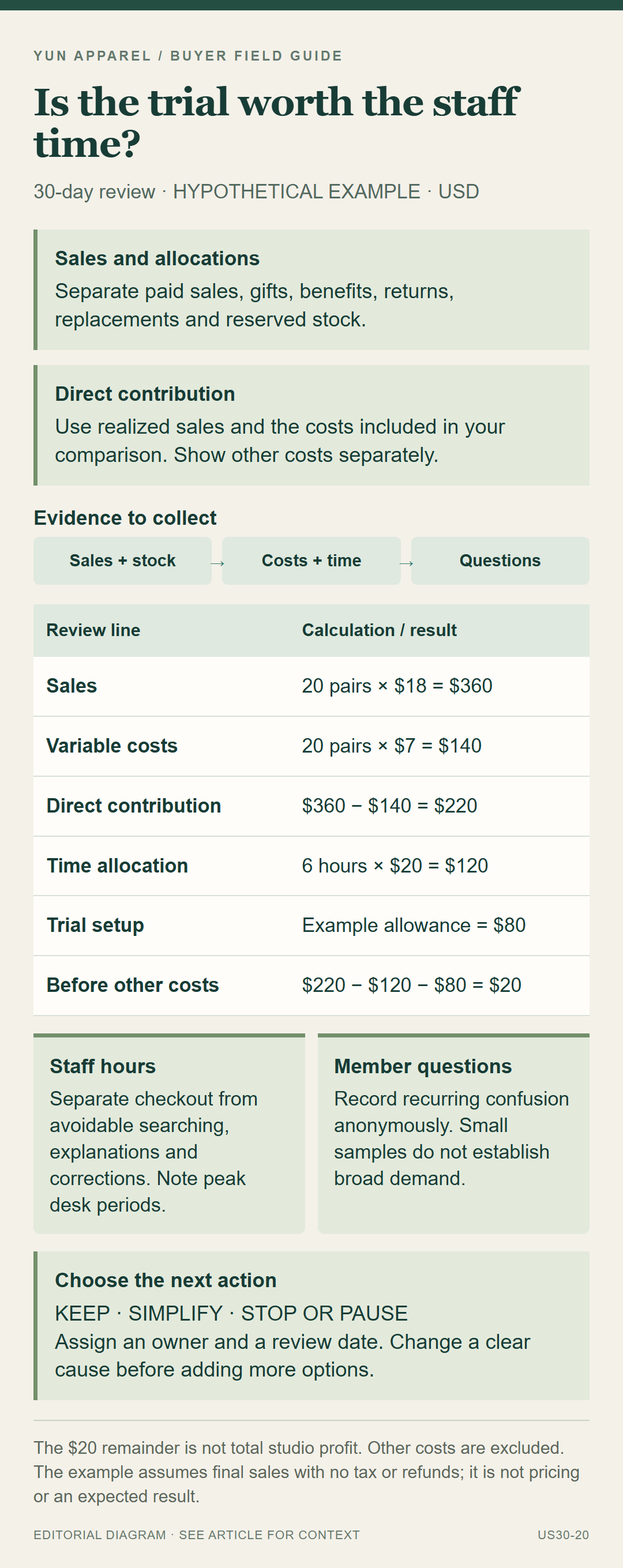
Concept illustration. The $20 remainder is not total studio profit. Other costs are excluded. The example assumes final sales with no tax or refunds; it is not pricing or an expected result.
Separate sales from other stock movements
Start with the quantities sold, gifted, issued as membership benefits, returned, replaced and still reserved. Reconcile those categories with the opening stock, receipts and remaining stock. A product leaving the shelf is not automatically a sale, and an exchange should not be counted as a second paid purchase.
Record the actual realized selling price after the discounts included in your review, with returns or other adjustments identified consistently. Keep campaign gifts visible in their own allocation. That prevents a popular giveaway from appearing as a successful retail launch simply because many pairs were distributed.
Lake Yoga's published challenge program links member activity with merchandise rewards. It is an example of an announced activity, not proof of increased retention, sales or profit. Lake Yoga Holiday Flash Challenges 2026 Apply the same evidence discipline to your own review: report what your records establish.
Define what the financial comparison includes
Use a clearly scoped contribution calculation and then show additional costs separately. The SBA's calculator distinguishes price, variable costs and fixed costs. US Small Business Administration break-even calculator Do not label the remainder from a narrow merchandise worksheet as the whole studio's profit.
The following is a hypothetical US-dollar example for a trial, not Yun Apparel pricing or an expected business result. Assume the 20 sales are final for the example, with no tax or refund amounts included.
| Review line | Hypothetical calculation | Amount |
|---|---|---|
| Merchandise sales | 20 pairs × $18 | $360 |
| Included variable costs | 20 pairs × $7 | $140 |
| Direct contribution | $360 − $140 | $220 |
| Staff-time allocation | 6 hours × $20 planning rate | $120 |
| Trial setup | Recorded example allowance | $80 |
| Remainder before other costs | $220 − $120 − $80 | $20 |
The example's $20 is not a complete profit figure. Other relevant costs may remain outside the scope. The worksheet makes the chosen assumptions visible so the owner can compare alternatives consistently rather than focusing only on the $360 sales total.
Record where staff time went
Separate routine retrieval and checkout from avoidable work: searching for sizes, explaining unclear bundles, correcting benefit records or reopening packaging. Use short task categories that staff can record without creating another large administrative burden.
Ask whether the workload occurred at the busiest desk periods. Two offers with similar total handling time may affect the studio differently if one repeatedly interrupts check-in. Review the causes with staff before concluding that merchandise itself is the problem.
Collect a few recurring member questions in anonymous form. Confusion about included items, size selection or care information may point to a fixable presentation issue. Do not turn a handful of comments into a statistical claim about all members.
Choose what changes for the next period
Keep the elements that have a clear role and manageable operation. Simplify a configuration that creates repeated checkout questions. Pause a product whose information or supply scope is unresolved. Stop an offer if the owner decides its costs and workload do not support the intended objective.
Write the next action, owner and review date. If the change is a clearer size display, evaluate that change before simultaneously adding several colors and another accessory. Otherwise, the next review may struggle to identify what caused the difference.
Questions studio owners ask
Should we count existing employees' time if payroll did not increase?
Record the time so the owner can see the workload and competing tasks. If you assign a planning value, label it clearly and avoid counting the same cost twice. The purpose is a consistent management comparison.
Does a small first-month sample justify expanding the range?
Treat it as early evidence. Review the product mix, unusual events and unresolved questions before committing more resources. One busy launch week may not represent ordinary demand or the ongoing workload.
Turn the review into a focused supply brief
Share the specific product, packaging or assortment changes you want to evaluate with Yun Apparel. Use the review to scope the next custom cotton sock or coordinated accessory proposal, with actual options and costs confirmed before another commitment.