Check the Contribution Behind a Studio Merchandise Discount
Compare a studio merchandise discount with the contribution it leaves, using a transparent example and clear rules for eligible products and rewards.
A merchandise discount reduces the money left from each sale unless another part of the cost changes. Before announcing a promotion, calculate the contribution at the proposed selling price and decide which products and members qualify. A busier retail shelf does not automatically mean that the studio has earned more from the offer.
Use the actual quoted product and fulfillment costs where known. Keep estimates marked as estimates, and do not borrow a competitor's discount because its website makes the offer look attractive. Your purchase terms, stock position and operating workload may be different.
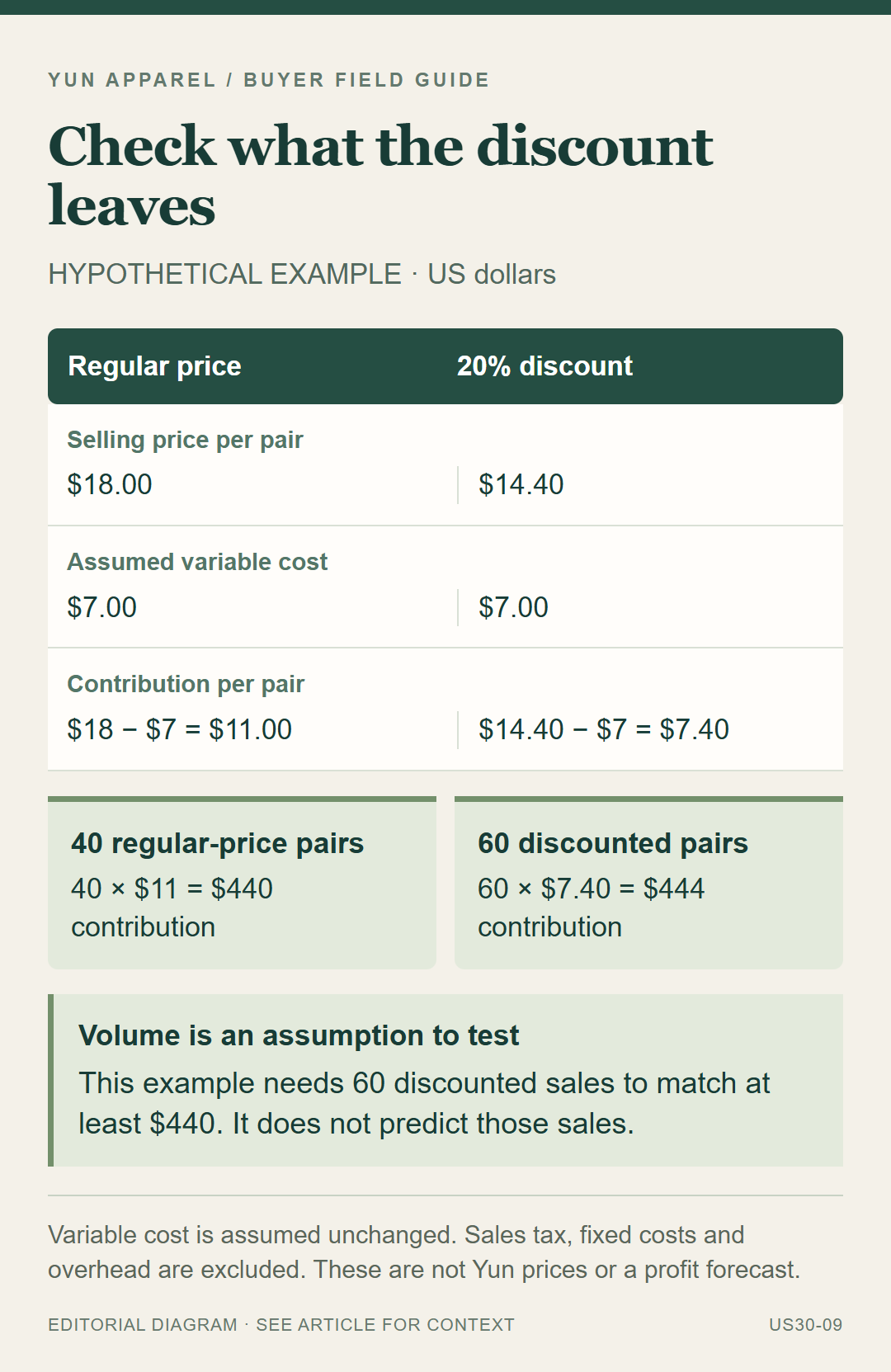
Concept illustration. Variable cost is assumed unchanged. Sales tax, fixed costs and overhead are excluded. These are not Yun prices or a profit forecast.
Start with a consistent cost scope
For a simple planning comparison, contribution per unit equals the selling price less the variable costs included in the model. The SBA's break-even calculator uses price and variable cost separately from fixed costs. US Small Business Administration break-even calculator Decide which costs your own worksheet includes before comparing two prices.
Possible inputs include the product cost allocated to each pair, packaging, transaction charges and fulfillment costs that vary with the sale. Check whether freight or packing is already included in the product figure so it is not counted twice. Separate fixed campaign setup and general overhead from the per-unit comparison.
If a fee changes with selling price, calculate it for each scenario. The example below deliberately holds the total variable cost constant to make the effect of the discount visible; that assumption may not match your actual payment or delivery arrangement.
Compare the offer with a clear example
These are hypothetical US-dollar figures, not Yun Apparel prices, suggested retail prices or a sales forecast. Sales tax and fixed overhead are excluded from the example.
| Item | Regular-price scenario | Discount scenario |
|---|---|---|
| Selling price per pair | $18.00 | $14.40 |
| Discount from example regular price | None | 20% |
| Assumed variable cost per pair | $7.00 | $7.00 |
| Contribution per pair | $11.00 | $7.40 |
At those assumptions, 40 regular-price sales contribute $440. Matching that amount requires at least 60 discounted sales, which contribute $444. This calculation does not say the promotion will produce 60 sales. It shows the additional unit volume the example would need before fixed costs are considered.
If expected volume is uncertain, compare several scenarios. Include one where sales do not rise at all. The owner can then decide whether the planned discount is justified by a defined objective, such as a specific stock reduction, rather than by an assumed increase in demand.
Make eligibility easy to administer
Lake Yoga's November 15–23, 2026 challenge announcement connects qualifying participation with merchandise discounts. As of November 18, that announced period is still underway; it is not a completed-results case study. Lake Yoga Holiday Flash Challenges 2026 The practical lesson for your own offer is to define how eligibility will be recognized.
Write the start and end point, eligible items, eligible recipients, combination rules and the way staff will record redemption. If a membership benefit already includes a pair, distinguish that handover from a discounted retail sale. Avoid leaving staff to decide whether offers can be combined during checkout.
Check the final basket, not just the headline
For a mixed bundle, calculate the cost of the actual included items and packaging. If customers can choose between differently priced products, test the most expensive permitted combination as well as the common one. A single attractive headline price can conceal an unexamined configuration.
After launch, compare actual units, realized selling prices, returns or adjustments and the costs included in the original model. Keep your method consistent. Changing the cost scope halfway through the review can make the promotion appear better or worse without reflecting a real operational change.
Questions studio owners ask
Does positive contribution mean the promotion is profitable?
It means the included selling price exceeds the included variable costs. Fixed campaign costs, overhead and other relevant expenses still need consideration. Do not label a narrow contribution calculation as the studio's overall profit.
Should we match another sock brand's holiday offer?
Use it as market context, then evaluate your own product and costs. Another brand's pack quantity, stock, fees and campaign goals may differ. Its advertised discount does not establish an affordable promotion for your studio.
Obtain comparable product costs
Send Yun Apparel the proposed custom sock assortment, packaging and destination. Ask which costs are included in each quoted line before building a studio promotion around the figures.