Build a Transparent Budget for Studio Sock Giveaways
Plan a sock giveaway with separate commitment, fulfillment and cost records, including packaging, handling and a clearly labeled sample budget.
A sock giveaway has a cost even when the recipient pays nothing for the pair. Keep the merchandise budget visible instead of assuming that membership revenue absorbs it. Record what the studio has promised, what it has purchased and what it has issued, then review the campaign without confusing those three quantities.
This is a management planning worksheet for a small studio. It helps an owner see the resources committed to a promotion. It is not a statement about accounting or tax treatment, and it does not establish how many memberships a gift will generate.
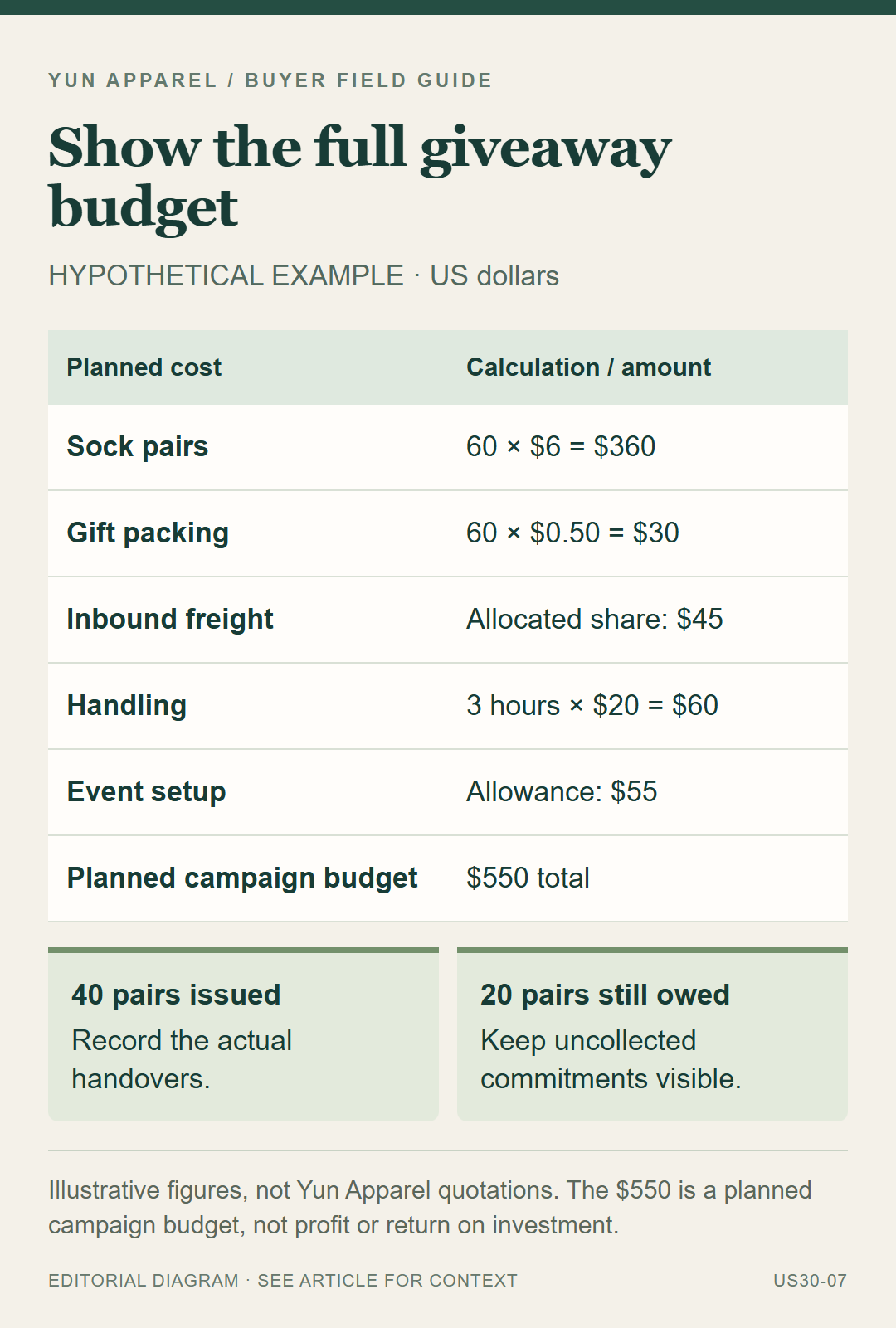
Concept illustration. Illustrative figures, not Yun Apparel quotations. The $550 is a planned campaign budget, not profit or return on investment.
Define who can receive the gift
Write the eligibility rule in a form staff can apply: a specific membership offer, confirmed event registration or another approved condition. Establish the campaign limit and the process for closing the offer before announcing it. A vague “free socks for members” message can create more commitments than the stock plan covers.
Lake Yoga's 2026 challenge announcement includes merchandise discounts and branded prizes. It illustrates a published connection between member activity and merchandise, without proving sock procurement or campaign results. Lake Yoga Holiday Flash Challenges 2026 Your budget should reflect your own promise and the cost of honoring it.
Separate commitment from issue
Use three counts: eligible confirmed recipients, items acquired for the campaign and items handed over. Add a fourth count for items still owed. An uncollected but promised pair remains relevant to the plan even though it has not left the studio.
If an item is moved from normal retail stock into the campaign, record that allocation. It did not become costless because the studio already owned it. Equally, avoid charging the same pair twice through both an event purchase list and a retail transfer record.
Build the cost from its components
Ask the supplier which costs are included in the quotation. Add packaging, allocated inbound transport and handling only where they are not already included. The SBA's break-even calculator distinguishes fixed costs from costs that vary with volume; that distinction is useful when building a consistent planning model. US Small Business Administration break-even calculator
The following figures are hypothetical US dollars, not Yun Apparel prices or a recommended campaign size.
| Planned component | Hypothetical calculation | Amount |
|---|---|---|
| Sock pairs | 60 × $6 | $360 |
| Gift packing | 60 × $0.50 | $30 |
| Allocated inbound freight | Campaign allocation | $45 |
| Handling time | 3 hours × $20 planning rate | $60 |
| Event setup | One campaign allowance | $55 |
| Total planned budget | Sum of the rows above | $550 |
The planned cost averages about $9.17 per allocated pair when all 60 are included. If only 40 have been issued so far and 20 are still owed, dividing $550 by 40 produces $13.75 per issued recipient to date. That second figure is a temporary fulfillment view, not proof that the cost of each sock changed.
Compare the plan with actual spending
At the review date, replace estimates with recorded charges where available and identify remaining estimates. Explain any extra packaging, additional transport or staff time. Keep costs for unused stock visible, with an approved next allocation if it is no longer committed to recipients.
Report the campaign's operational outcomes separately: gifts promised, gifts issued, unresolved collections and questions received. Membership signups during the same period may be worth observing, but they do not establish that the gift caused those signups. Avoid turning simultaneous events into a return-on-investment claim.
A useful next decision might be to simplify packaging, narrow eligibility or improve collection scheduling. It need not be to increase the next giveaway merely because every available pair was distributed.
Questions studio owners ask
Should a free pair be valued at its retail selling price in the budget?
Use the actual relevant cost basis for the planning question and show it clearly. A retail price can describe an advertised offer where appropriate, but it is not interchangeable with the studio's acquisition and fulfillment costs.
What if some members never collect their gifts?
Keep the outstanding commitments visible and follow the terms actually communicated. Do not automatically treat every uncollected pair as available retail stock. Resolve the commitment before changing its allocation.
Request a quote that supports the budget
Ask Yun Apparel to separate the proposed custom cotton socks, branding, packaging and any additional quoted services. Share the intended gift quantity and destination so your planning sheet can identify inclusions and open costs accurately.